
Intuitive Screenwriting System: Orientation
Start here.

If you are new here, this may help.
The posts on Intuitive Screenwriting may look like separate essays, notes, or film reflections, but they are not random. They are building one unified theory of story, with a specific focus on feature-film structure.
The website is organized very simply through four main categories: Introduction, Theory, Story Diagnostics, and Film Breakdowns.
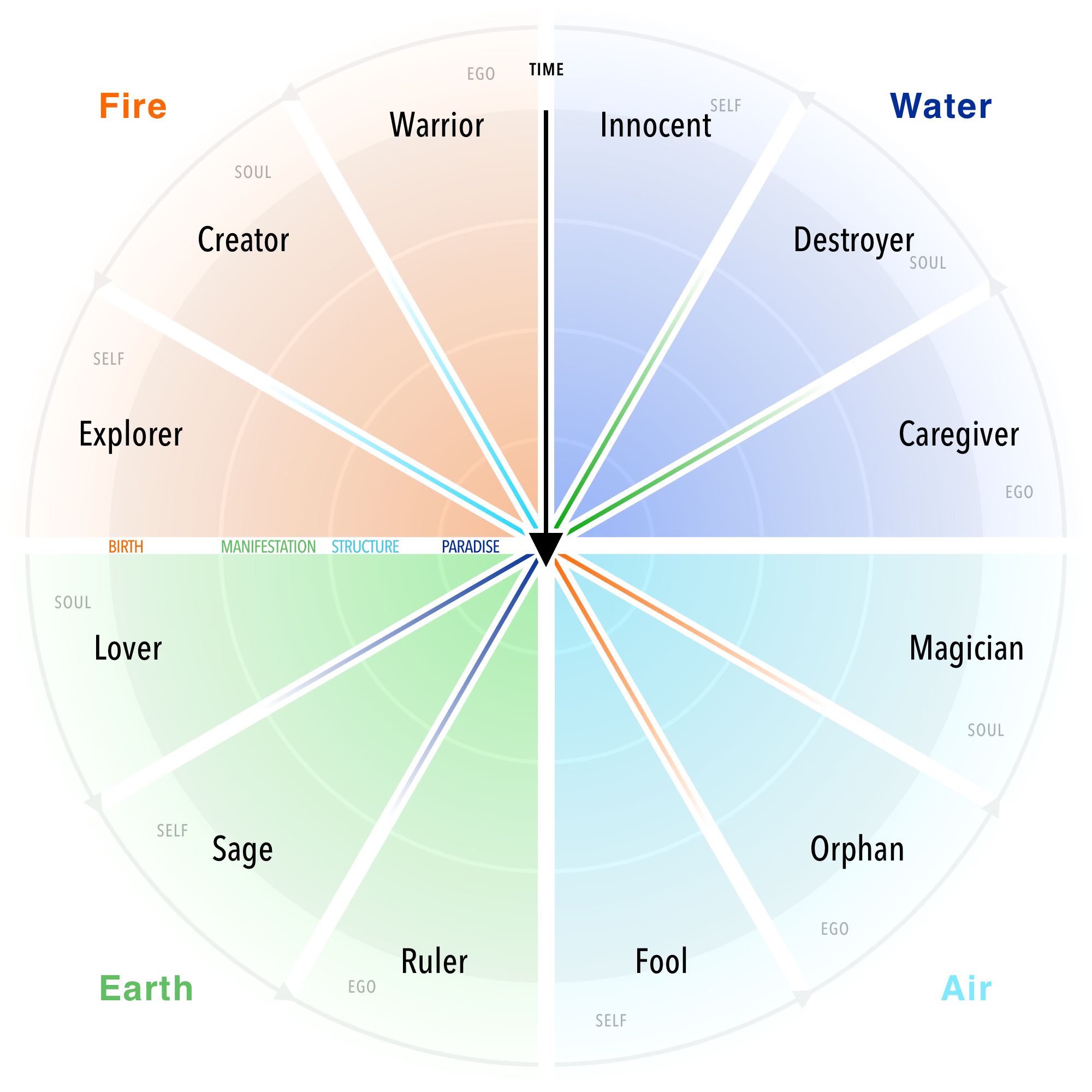
At the center of the theory is the Intuitive Screenwriting Wheel: an original archetypal wheel built from 12 archetypes in precise relation to one another. Each archetype has its own elemental and psychological properties, connected to different levels of the psyche. The Wheel is not a classification of archetypes, but a living matrix of story, where archetypes communicate, oppose, attract, and transform each other. This is why I understand the Wheel as both a blueprint of the psyche and a blueprint of narrative.
Some of the broader positioning of the system can be found in the Story Mandala and in my comparison between Save the Cat, the Hero’s Journey, and Intuitive Screenwriting.
Some parts of the work move beyond screenwriting itself, into psychology, mythology, symbolic systems, and the deeper geometry of narrative structure.
The theory begins with the 12 archetypes and their properties.

From there, it moves into archetypal axes and genre theory: the idea that genre is not a surface category, but a deep civilizational story pattern.
The first major layer is the map of 12 archetypal genres, built from archetypal axes.


The first six form the primary genre map, and the next six complete the larger system.
From this genre map comes the 4-act structure: The Magic Cross, from Genre to Structure. In Intuitive Screenwriting, the four acts are not imposed from outside. They emerge from the archetypal tension of the genre itself.
This is also where the system becomes practical:
From Logline to Four Acts, from idea to structure, from intuition to map.
After that comes the next layer: linear transformation, which I call The Feature Film Clock: The Circle of Transformation in Four Acts and Twelve Stages.
The archetypal logic does not stop at genre, it also organizes stages. The 12 stages of a feature film are not random beats. They are structured through the same archetypal axes that organize genres, showing how transformation unfolds across the whole film.
Throughout the system, I also use detailed film examples and structural breakdowns of well-known films to show how the patterns operate in practice.
If I had to name the one thing that makes this model different, I would say its fractal nature. The same archetypal logic repeats across genres, acts, phases, and eventually scenes.
Here, on Substack, I am opening the system layer by layer, so readers can follow how each level of structure emerges from the one before it.
Where I am going next.
I will begin moving through the 12 stages one by one, showing what archetypal dynamics stand behind each part of a feature film.
The upcoming work on the 12 stages is for screenwriters, filmmakers, novelists, storytellers, and serious readers who want to understand archetypal transformation and long-form narrative structure more deeply.
The introductions and foundational essays will remain open.
The deeper architectural layer, the 12-phase breakdowns, applied structure, and practical implementation of the system, will be for paid readers.
This allows me to continue developing the Intuitive Screenwriting method, including the larger software framework that has emerged from it.
Also, for readers who want to go deeper, I will soon publish a cornerstone text on the core mechanics of the Wheel: how the archetypes relate, move, and generate structure.
Hello Ana! I just want to mention how profound I think your intuitive screenwriting framework is.
For me, superheroes have always been very inspiring to me and I wanted to dive deeper into why that is. I have been doing research on the Hero's journey and was looking for ways to turn it into something that could help people navigate their lives in this complex reality. Your work explains the friction I was feeling, that the hero's journey is rather linear and does not always resemble the psychological tension that defines the underlying narrative of a story. I am going to continue writing about modern heroism, and your matrix will help me a lot with that. Thank you!